
🗿 Archaeological Highlights of Altai mountains
12,000 Years of Civilizations at the Crossroads of Central Asia
🌍 A Crossroads of Empires & Cultures
Located in far western Mongolia, Bayan-Ölgii has long stood at the intersection of empires, migrations, and trade routes—just north of the legendary Silk Road. For over 12,000 years, waves of peoples have passed through or settled this land, leaving behind an extraordinary archaeological record.
🧭 Peoples Who Shaped the Region
- 🏹 Early hunter-gatherers (from ~10,000 BC)
- 🐎 Turkic ancestors emerging from the Altai (~2000 BC)
- 🛡️ Scythian nomadic warriors expanding west after 700 BC
- ⚔️ Huns, migrating toward Europe around 100 AD
- 🌲 Tuvans, reindeer herders of the northern forests
- 🐎 Turkic–Uighur tribes (6th–13th centuries)
- 🏹 Mongol Empire (13th century), spanning Korea to Poland
- 🐎 Kazakh Khanate (from the 15th century)
- 🏰 Later influence from Qing China and Imperial Russia (19th century)
This layered history makes Bayan-Ölgii one of the richest archaeological landscapes in Central Asia.
❄️ Why the Past Is So Well Preserved
Thanks to a cold, dry climate and sparse population, ancient artifacts have survived in remarkable condition. Surveys estimate:
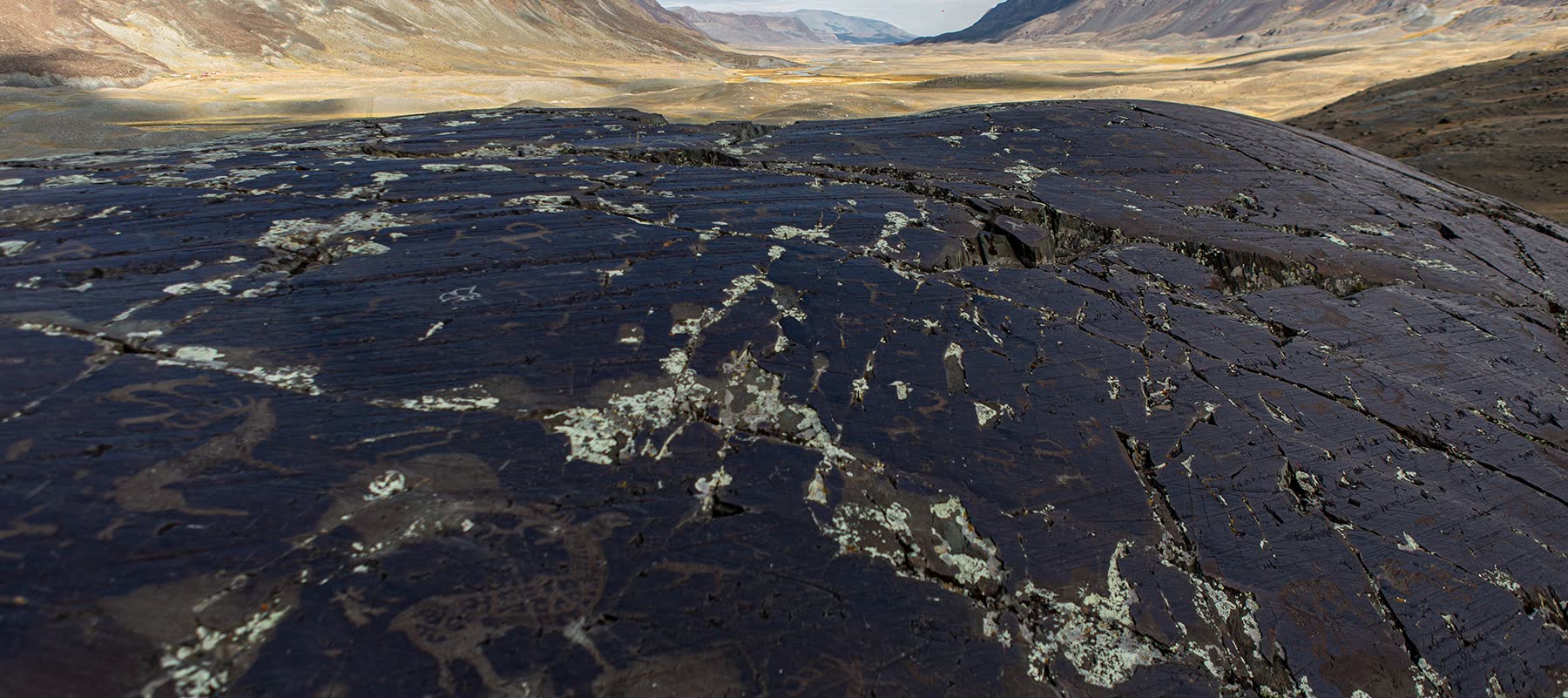
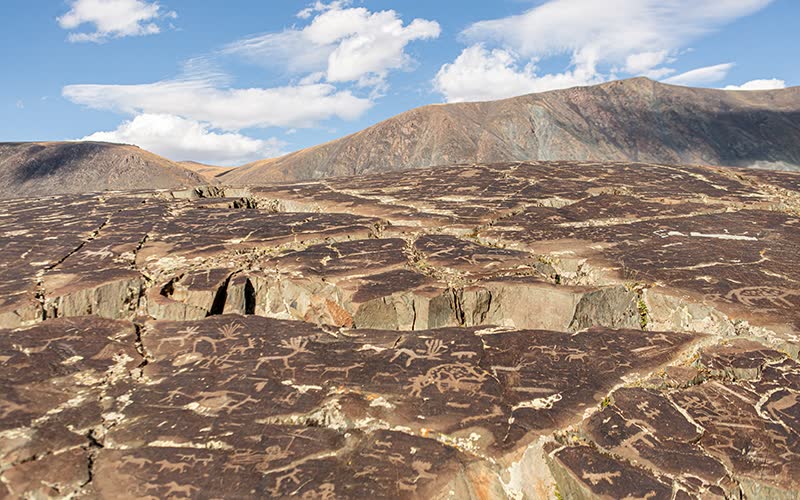
- 🪨 Hundreds of thousands of petroglyphs
- 🗿 Over 1,000 stone monuments
- 🦌 ~50 deer stones
- ⚰️ Numerous tombs, burial mounds, and ancient graves
These remains allow archaeologists to trace the evolution from hunter-gatherers → pastoralists → semi-nomadic herders, the roots of today’s ger-dwelling nomads.
🖼️ Petroglyphs: Stories Etched in Stone
Petroglyphs dating from 10,000 BC to ~100 AD—created by early Turkic groups and the Huns—depict:
- 🦌 Wild animals and livestock
- 🏹 Hunting scenes and rituals
- 🐎 Early horse culture
- 🛖 The beginnings of pastoral nomadism
Through these images, visitors can see direct connections to the living nomadic culture of Bayan-Ölgii today.
⭐ Tsagaan Salaa – A World-Class Site
According to Lonely Planet, Tsagaan Salaa in Altai Tavan Bogd National Park is the best place in Central Asia to view petroglyphs—over 10,000 carvings spread along a 15 km river valley.
🗿 Standing Stones & Sacred Monuments
From around the Bronze Age onward, communities began erecting standing stone monuments to honor ancestors—some reaching up to 4.5 meters (15 ft) tall.
Types Found in the Mongolian Altai
- 🦌 Deer stones – featuring flying deer motifs
- 🗿 Turkic image stones
- 🪨 False image stones
- 🧍 Balbals – lines of stones marking memorial sites
Many stones were reused or newly erected well into the Mongol Empire era.
⚰️ Burial Mounds & Ritual Sites
Across Bayan-Ölgii you’ll find diverse funerary structures:
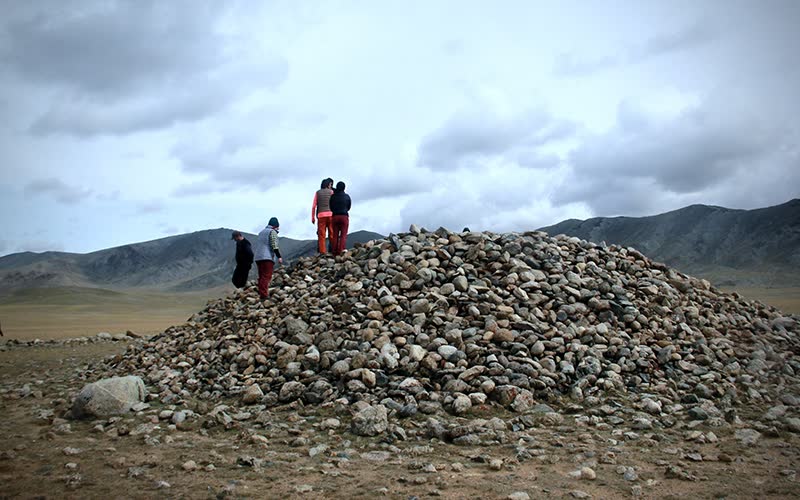
- 🪨 Khirigsuur (large stone mounds)
- 🏺 Turkic memorial complexes
- 🛖 Dwelling monuments
- ⚰️ Ancient graves and altars
🧬 Notable Discovery: In 2005, an expedition uncovered a mummified Scythian warrior in full battle regalia beneath a khirigsuur—one of the most important archaeological finds in western Mongolia.
🧭 Visiting the Archaeological Sites
- 🏛️ Ölgii Aimag Museum displays selected deer stones and image stones
- 🚙 The best sites are concentrated a few hours’ drive west of Ölgii
- 🧑🏫 Local guides offer expert interpretation and tailored tours
- 🗺️ Most Altai itineraries include archaeological stops
- 🧾 Archaeology-focused tours are available for deeper exploration
These journeys uniquely combine ancient history with living nomadic cultures—Kazakh, Tuvan, and Mongolian.
🌐 UNESCO World Heritage
These sites collectively form part of the UNESCO World Cultural Heritage listing for the Petroglyph Complexes of the Mongolian Altai, recognizing their global historical value.
⭐ Why Bayan-Ölgii Archaeology Matters
- ✔ One of Central Asia’s richest archaeological regions
- ✔ Exceptional preservation due to climate
- ✔ Direct link between ancient art and modern nomadic life
- ✔ UNESCO-recognized cultural heritage
- ✔ Ideal blend of history, culture, and wilderness travel